The Restored T206 Wagner: Why the Hobby’s Grail Sold at a Six-Year Low

All Vintage Cards content is free. When you purchase through referral links on our site, we earn a commission. Learn more
A T206 Honus Wagner sold at auction this weekend for $1.33 million. In any other corner of the hobby, that’s a big return that warrants celebration. However, in the Wagner market, it’s the lowest price a T206 Wagner has sold for in roughly six years. But, beneath it all, is the story of a former ESPN celeb and restoration, that as shown by the sales price, was not viewed favorably by the market.
Before we get to analyzing the market return, you need to hear the story. Because this isn’t just a restored Wagner. This is the “Die-Cut Wagner”. It spent nearly three decades sitting on Keith Olbermann’s desk as a paperweight, and the person who restored it has never been identified.
Want To Save This Article?
Drop your email and I'll send it to your inbox — plus weekly vintage card news, deals and insights.
From a Dollar Bin to a Nickname
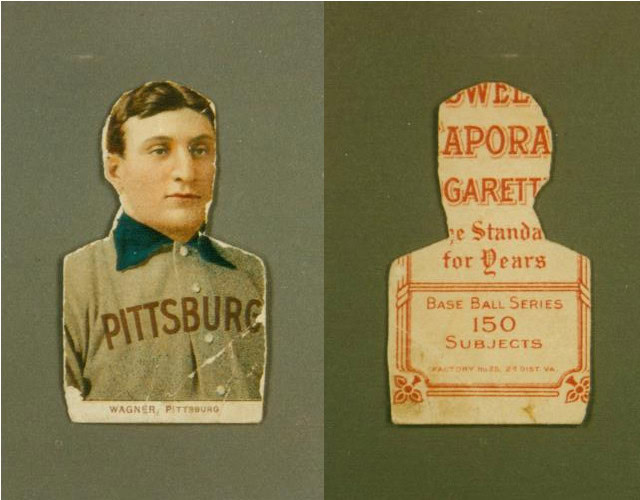
The card’s documented history starts in a New Jersey card shop in the mid-1970s, where a collector bought it for one dollar. There was a reason it was a dollar: someone had trimmed away almost the entire background, cutting tightly around Wagner’s portrait. The hobby gave it a nickname — the “Die-Cut Wagner” — and it became one of the more infamous altered examples of the most famous card in the world.
Even mutilated, it was still a Wagner. The card sold at auction in the mid-1990s for close to $10,000, and then it vanished from public view entirely. For thirty years, nobody in the hobby knew where it was.
AVC Acquisitions Portal

Sell Your Card Collection
Skip the listing process and long wait times. Get a professional offer on your collection within 48 hours. See our buy list.
It turned out to be hiding in plain sight — in a Lucite screw-down holder, holding down papers in a broadcaster’s home office.
The Olbermann Chapter
Keith Olbermann is one of the most sophisticated vintage collectors in the hobby, and in the late 1990s he did something quietly radical. After sending a 1933 Goudey Nap Lajoie to a restorer as a test — and being stunned by the results — Olbermann proposed a bigger experiment: restore a truly high-profile card and then reveal the work publicly, forcing the hobby to confront the question of ethical restoration head-on.
The conservator told him he had access to the perfect candidate: a T206 Wagner. In his own essay, “I’m Honus, Dammit,” published on Love of the Game’s auction site, Olbermann writes:
“The restorer said he had a lead on a bad Honus that he thought would be a superb candidate for restoration because while overall it was in terrible shape there were critical parts of the card that were unravaged. He’d have to do months of painstaking work but large areas of it would need nothing but a little cleaning. That’s all I ever knew about the card in its mid-‘90s form. We agreed on a price – $75,000 to cover the card and his work – and we agreed on a schedule of installment payments”.
What came back to Olbermann in December 1998 was a Wagner with clean borders, square corners, strong centering, and a Sweet Caporal back. And that was the problem. Olbermann had never seen the original Die-Cut Wagner in person, and the card in his hands looked too good. Was it real? Had the restorer been straight with him? When he tried to contact the conservator to settle his doubts, the man had disappeared entirely — Olbermann has described him as vanishing like a ghost.
Unable to resolve what he was holding, Olbermann screwed the card into a Lucite holder “pending further investigation.” The investigation took twenty-eight years. In the meantime, the most storied restored card in the hobby served as a paperweight.
The “Wagner?” in its holder sat in my home for… well, as you’re reading this, what time is it now? I should write “homes.” I moved at least seven times and each time I didn’t even hand carry the card. I left it for the movers. At least once that is literally what I did: told the movers to pack up everything and meet me at the new place. Including that big Lucite brick with the old timey picture in it. In between moves the card really did evolve into a kind of paperweight. I didn’t want to know if it was less than advertised.
The Rediscovery
This past spring, Olbermann bought some cards on eBay and the seller mentioned that Olbermann had purchased his ‘Die Cut Wagner’ that sold at auction back in the 1990’s. Olbermann initially had no idea what he meant — then remembered the paperweight.
And then came the third serendipitous event. In the spring of this year I bought a card on eBay and as the transaction completed the seller messaged me. He threw in thanks and shipping details and something about being told that 30 years ago that I had bought his Wagner from an infamous restore. Even though I recognized all the words (except “infamous restore” – what’s a “restore”?), it still didn’t register. Sounded like the result of a particularly hearing-challenged game of Telephone. I said I didn’t know what he was talking about (and to be fair, I didn’t, because I’m a moron) and asked for details. It was, he said, the famous Die-Cut Wagner, a Honus trimmed long-ago of everything but the head, chest, and name, which hadn’t been seen since – of all people – my friend Lifson had auctioned it off in the ‘90s.
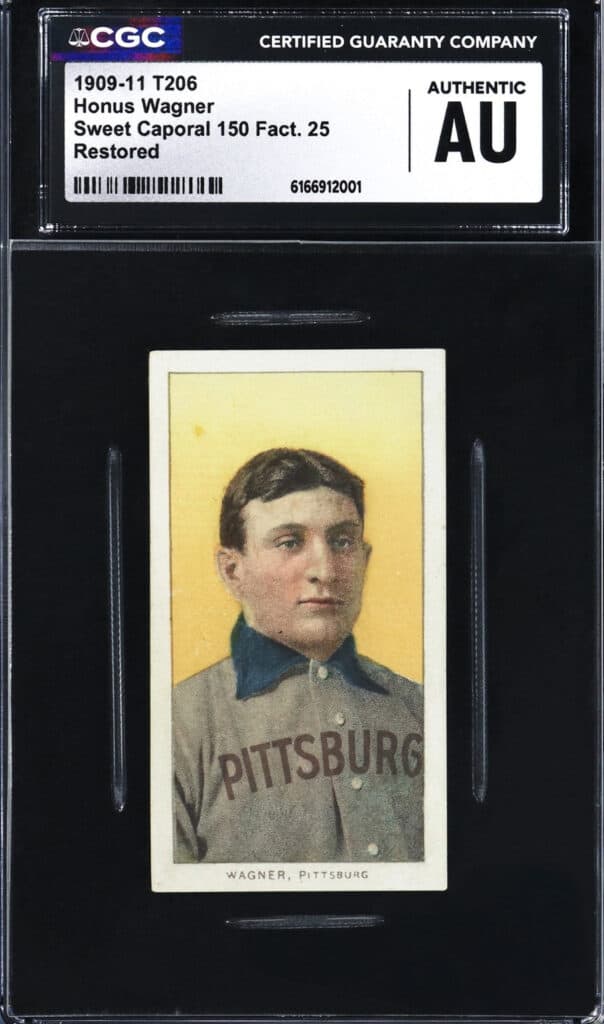
A side-by-side comparison of a high-resolution scan of the original Die-Cut Wagner against the restored card made the match clear: the portrait, the surviving original paper, the silhouette — it was the same card. CGC’s Andy Broome, VP of Grading, confirmed it through careful forensic evaluation, and the card was slabbed “Authentic – Restored,” the first T206 Wagner CGC has ever authenticated.
As you can imagine, being die-cut, Honus’ portrait was cut around his head and shoulders, it’s in the name, die-cut, and we could see where that was put together, we could see some of the adhesives that were used, we could see where color was rematched in painting to essentially make it seamless, and we were able to detect that the parts were of the card were from a donor T206 card and matched up beautifully, and so we just confirmed what Keith figured out after many years, that this in fact was what’s known as the die-cut Wagner that has been restored.” – Andy Broome, CGC Grading — Source, Hollywood Reporter
Love of the Game Auctions made it Lot #1 of their Summer 2026 auction, with full disclosure of every chapter of the story. Bidding closed August 8.
What the Restoration Actually Involved — And How You’d Catch It
I thought the above video did a good job comparing the original die-cut Wagner to the restored Olbermann card with the consensus that the card is about 50% real and 50% fake.
The restorers work involved sourcing several T206 cards and merging them into the surviving original card so seamlessly that even Olbermann thought the card looked too good and questioned its authenticity.
Here’s the description of the work on the card as explained by Love Of The Game (LOTG) auctions:
The restoration work is impressive. Several creases and spots of paper loss on the original “Die-Cut” have been repaired, and then a donor card was matched to the die-cut to provide its new background. The background is somewhat more yellow than is typical of most T206 Wagners, a characteristic that relates directly to the restoration process. Because the restoration utilizes an authentic T206 card, the conservator selected a donor card that could be completely eclipsed by Wagner’s image. The resulting gradient background serves as one of the few readily identifiable indications of the conservation work. Masterful inpainting smoothed the areas between the original and its new background and lettering, a very slightly raised surface around the “die-cut” leaving only faint evidence of its presence. A second donor card provides the authentic Sweet Caporal back. The resulting work earned the assessment of “Authentic – Restored” from CGC – the first T206 Wagner they have ever graded. It is an incredible card – beautiful, clean, and with one of the more memorable backstories of any Wagner.
But here’s the thing — the work was detectable even as pointed out by LOTG above. Olbermann eventually found it himself: he removed the card from its holder and ran his fingertip slowly across the surface, from the background onto Wagner’s head. It wasn’t flat.
The original portrait sat at a subtly different level than the restored background. Olbermann also notes that “under black light and more sophisticated rays and lights, you can see exactly where the restorer attached the new background from another T206 card”, and “the clean back, probably from yet another one. It’s not just the kind of legit above-board restoration I had fantasized about thirty years ago, it’s a masterpiece”.
As a collector I have many mixed opinions about restoration of old cards such as this. Anyone is certainly entitled to do whatever they want with their own card, and as long as it’s not done to fool anyone, and the restoration is fully disclosed, it’s totally fine.
The Market’s Verdict
Per Chris at T206BaseballCards.com, the $1.33 million hammer represents the lowest T206 Wagner sale in about six years — in a market where unaltered low-grade Wagners have traded for multiples of that figure.
In my estimation, an unaltered Wagner in this condition would easily top $10 million, so the auction result shows collectors are hesitant to commit full market price for something this heavily altered, no matter how well the work was done.
For decades, the hobby has debated what disclosed restoration is “worth” in the abstract. This weekend, the market answered with a real number, on the most famous card in existence, with the most transparent disclosure imaginable. A restored Wagner is worth seven figures — and roughly a fraction of an honest, unaltered example.
That’s actually a pretty healthy result. It says alteration carries a permanent, massive discount even when the work is museum-quality — which is exactly the incentive structure you want if you care about original cards. And it says a card’s story has real value: without the Olbermann provenance, the vanished restorer, and the paperweight years, this card doesn’t come close to $1.33 million.
Olbermann’s stated goal back in 1998 was to force a public conversation about ethical restoration. It took twenty-eight years and a message from an eBay seller, but he got his conversation — and the market got its answer.


