
T206 Honus Wagner Card: The Holy Grail of Baseball Cards


All Vintage Cards content is free. When you purchase through referral links on our site, we earn a commission. Learn more
The 1909 T206 Honus Wagner is one of the rarest baseball cards in history and consistently ranks among the most valuable cards in the hobby. No investor has ever lost money buying one. Here’s everything you need to know about the card’s history, rarity, values, and investment potential.
The T206 Honus Wagner is one of the rarest and most valuable baseball cards ever produced. Approximately 50–100 copies are believed to exist, with just 53 graded across PSA and SGC. Even the lowest-grade authenticated copies have sold for over $3.5 million. A PSA 1 sold for $5 million in February 2026 — and the sole PSA 8 in existence is estimated to be worth $25 million or more.
| Known to exist | ~50–100 copies |
| Total graded (PSA + SGC) | 53 |
| Lowest recent sale | $3.6M (Auth, Feb 2026) |
| Highest recent sale | $5M (PSA 1, Feb 2026) |
| Record sale | $7.25M (SGC 2, Goldin, 2022) |
| Finest known | PSA 8 — est. $25M+ |
A History Of The T206 Honus Wagner Card
From 1909 to 1911, the American Tobacco Company (ATC) inserted baseball cards across its sixteen-brand tobacco packs.
Want To Save This Article?
Drop your email and I'll send it to your inbox — plus weekly vintage card news, deals and insights.
The cards were part of a promotion for ATC to keep customers loyal to its cigarette brands. Some believe the cards acted as an added ‘stiffener’ for the cigarette packs.

At the time of production, Wagner played baseball at an elite level and was sought after by many brands seeking to use his likeness.
AVC Acquisitions Portal

Sell Your Card Collection
Skip the listing process and long wait times. Get a professional offer on your collection within 48 hours. See our buy list.
The T206 Honus Wagner card story is folklore, but the summary goes something like this: The American Tobacco Company began producing the Wagner card early in its 1909 production run, but soon stopped making it. Many believe this was due to a cease-and-desist order from Honus Wagner, who ordered ATC to remove the card from the set.
Some believe Wagner wanted the card pulled since he did not want to be associated with a tobacco product and ruin his image. But many dispute this, noting that Wagner was a frequent user of chewing tobacco and that it was more likely due to a contractual dispute.

Scott Reader summed this up well in his fantastic piece about the T206 Set:
Some advanced T206 collectors, such as Olbermann, have argued that Wagner’s withholding of consent had less to do with an anti-smoking bias than money. These critics of the anti-smoking thesis note that Wagner was featured in advertisements for tobacco products (including cigars) leading up to 1909, and was an admitted user of chewing tobacco. From this, they conclude that Wagner’s pronouncements about moral objections to cigarette smoking were themselves, excuse the pun, a “smoke screen.” – Scott Reader, Inside T206
Whatever the reason for its early withdrawal, the result is one of the scarcest cards in the hobby.
How Many Honus Wagner T206 Cards Exist?
Estimates suggest that somewhere between 50 and 100 T206 Honus Wagner cards have survived and remain in circulation today. The Wagner was the lowest-produced card in the entire T206 White Borders set — production was halted early, likely in 1909, leaving only a fraction of the copies that would have existed had the card run its full course.
While the exact number of surviving Wagners will never be known, PSA and SGC population data give us the most concrete picture available.
T206 Honus Wagner — PSA & SGC Population
| Grade | PSA | SGC | Combined |
|---|---|---|---|
| Auth | 8 | 6 | 14 |
| 1 +1Q | 11 | 3 | 14 |
| 1.5 | 2 | 2 | 4 |
| 2 | 8 | — | 8 |
| 2.5 | — | 2 | 2 |
| 3 | 3 | 3 | 6 |
| 4 | 1 | 1 | 2 |
| 5 +1Q | 1 | 1 | 2 |
| 8 only 1 exists | 1 | — | 1 |
| Total graded | 35 | 18 | 53 |
Q = qualifier grade. PSA and SGC population data current as of April 2026. No T206 Wagner has ever been graded PSA or SGC 6, 7, 9, or 10. The PSA 8 is the sole high-grade example in existence across both grading companies.
PSA has graded 35 T206 Honus Wagner cards across all backs, with 2 additional qualifier grades. SGC has graded 18. Combined, 53 Wagner cards have been graded across the two major grading companies, including 14 copies authenticated but not assigned a numeric grade. GAI has also graded one T206 Wagner card. Beckett has never graded a T206 Wagner.
The grade distribution tells its own story. The vast majority of surviving Wagners are heavily worn — PSA 1s and PSA 2s account for the largest share of the graded population, reflecting more than 115 years of handling, storage, and circulation. Only one copy has ever achieved a grade above PSA 5: a PSA 8 (the Gretzky Wagner), which remains the finest known graded Wagner. No T206 Wagner has ever been graded PSA 6, 7, 9, or 10 by either PSA or SGC.

Scott Reader’s 2009 book Inside T206 estimated between 50 and 75 copies in existence, with survivors in Excellent condition or better numbering in the single digits. Given that we now know of 53 graded copies, the total population — including ungraded cards in private collections — is likely closer to 100.
The T206 Wagner Was Only Issued With Three Advertising Backs
One of the most important authentication facts about the T206 Wagner is that it was issued only with three advertising backs: the Piedmont 150, the Sweet Caporal 150 Factory 25, and the Sweet Caporal 150 Factory 30. The Sweet Caporal 150 Factory 25 is the most common of the three.

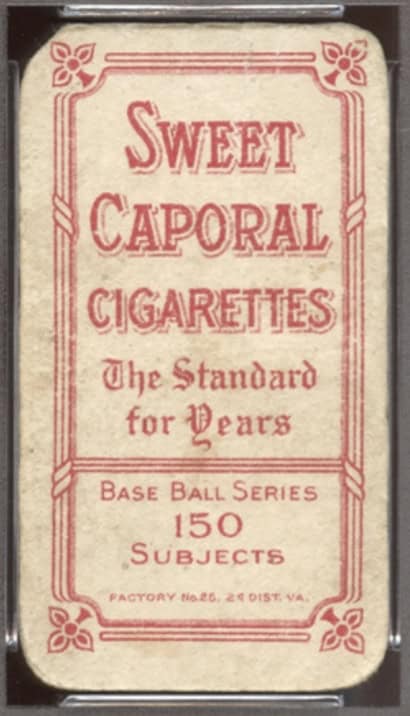
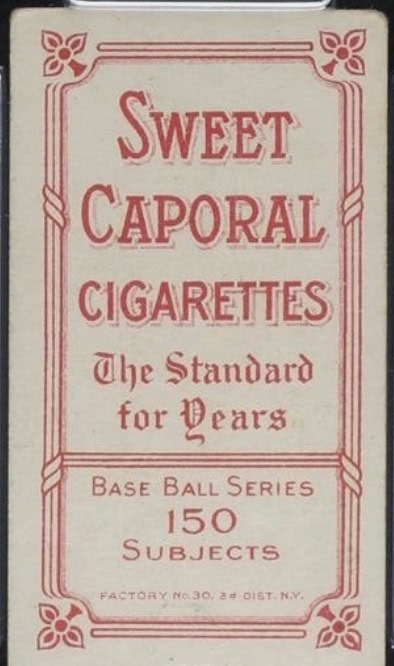
Any T206 Wagner card found with a different advertising back — most commonly a Polar Bear back — is a counterfeit. This is one of the most reliable and immediate authentication tells on the card, and it’s covered in detail in our guide to the Wagner’s limited backs.
→ How the T206 Wagner’s Limited Backs Help With Authentication →
How Much Is A T206 Wagner Worth?
T206 Honus Wagner — Estimated Value by Grade
| Grade | Estimated value | Notable sale |
|---|---|---|
| Auth | ~$3,600,000 | Sold Feb 2026 |
| 1 | ~$5,000,000 | Sold Feb 2026 |
| 1.5 | ~$5,500,000–$6,000,000+ | Last sold $3.7M in 2022 |
| 2 | ~$6,000,000–$7,000,000+ | Est. based on market trajectory |
| 2.5 | ~$7,000,000–$8,000,000+ | Est. based on market trajectory |
| 3 | ~$8,000,000–$10,000,000 | Est. based on market trajectory |
| 4 | ~$10,000,000+ | Est. based on market trajectory |
| 5 | ~$10,000,000–$15,000,000+ | Est. based on market trajectory |
| 8 only 1 exists | ~$25,000,000+ | Last sold $2.8M in 2007 |
Values are estimates based on recent auction results and market trajectory. Grades 6, 7, 9, and 10 omitted — no examples exist. PSA 8 estimate is speculative as it has not sold since 2007; value extrapolated from market appreciation of lower-grade copies. Est. = no recent public sale on record.
The market for T206 Wagner cards has continued to set records into 2026. In February 2026 alone, an Auth copy sold for $3.6 million and a PSA 1 sold for $5 million — making it one of the most active months in Wagner card history.
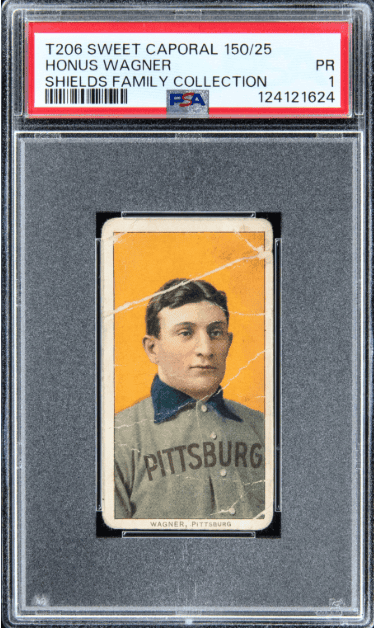
The $7.25 million Goldin private sale in 2022 remains the record for a single Wagner transaction, representing a Good condition copy. Even the most heavily worn examples — Poor-to-Fair-condition cards with significant creases — have sold for between $1.5 million and $5 million.

The PSA 8 is in a category of its own. Last sold in 2007 for $2.8 million, the finest known graded Wagner has never come back to market. Based on where lower-grade copies are trading today, a PSA 8 sale would almost certainly set an all-time record for any sports card ever sold.
The T206 Wagner as an Investment
Over the last 20 years, investors in a T206 Wagner card have outperformed the S&P 500 stock market index, averaging about 17% annualized returns. No one has ever lost money investing in a T206 Wagner card.
”There’s a reason why no Wagner card has never sold for less than it was previously purchased for – the card is art, it’s history, it’s folklore”. – Ken Goldin, Goldin Auctions
I’ve examined historical auction data for the T206 Wagner card across multiple grades, and the evidence is consistent — buyers who have held for 10, 15, or 20 years have done well. Not earth-shattering returns, but excellent and consistent appreciation.
Annualized returns based on documented auction transactions. S&P 500 returns are approximate total returns for the corresponding periods. Past performance does not guarantee future results.
PSA 1 example: A PSA 1 Wagner sold for $1.4 million at a 2020 auction. The same card had sold at auction back in 2004 for $101,000 — a 1,300% total return, or roughly 17.3% annualized over sixteen years. Over the same period, the S&P 500 returned approximately 8.8% annually. A Wagner purchased in 2004 outperformed the stock market by nearly 9% per year.

A second PSA 1 example: A card purchased for $399,000 in 2009 sold at Mile High Card Company in early 2022 for $3.1 million — again approximately 17% annualized over thirteen years.

PSA 3 example: A PSA 3 Wagner sold for $6.6 million at Robert Edward Auctions in 2021. A comparable PSA 3 had sold for $685,000 in 2008 — approximately 19% annualized over twelve years, beating the S&P 500’s 16% annual return over the same period.

The Wagner card is often compared to the Mona Lisa for its singular importance and scarcity in the hobby. Vintage cards have become an excellent diversifier for non-collectors too — a non-correlated asset class alongside art, antiques, and collectibles.
Even in a sports card bubble scenario, the Wagner should continue to appreciate — vintage sports cards hold their value exceptionally well even in deep recessions.
If there is one card in the hobby I could pinpoint as having minimal downside, it would be the Wagner. I know that 99.9% of those reading this can’t find or afford one — but the data makes the case that over a 20-year horizon, a T206 Wagner is likely to be one of the wisest investments a deep-pocketed collector can make.
Estimated T206 Wagner Values in 2040
A Wagner purchased sixteen years ago appreciated roughly 17% per year. One purchased in 2008 appreciated by nearly 12%. Splitting the difference and projecting at 15% annually, here’s what Wagner’s values could look like in 2040:
| Grade | Current est. value | Est. value in 2040 (15%/yr) |
|---|---|---|
| Auth | ~$3,600,000 | ~$25,000,000 |
| PSA 1 | ~$5,000,000 | ~$35,000,000 |
| PSA 1.5 | ~$5,750,000 | ~$40,000,000 |
| PSA 2 | ~$6,500,000 | ~$45,000,000 |
| PSA 2.5 | ~$7,500,000 | ~$52,000,000 |
| PSA 3 | ~$9,000,000 | ~$63,000,000 |
| PSA 4 | ~$10,000,000 | ~$70,000,000 |
| PSA 5 | ~$12,500,000 | ~$87,000,000 |
| PSA 8only 1 exists | ~$25,000,000 | ~$174,000,000 |
2040 projections assume 15% annual appreciation — the midpoint between the 12% and 17% annualized returns documented in historical Wagner transactions. These are speculative estimates for illustration purposes only and not financial advice. Current values are approximate based on recent auction results.
Anything can happen — that $3 million Wagner in Poor condition might not appreciate at the same rate as past copies. But if historical returns hold, it could be a $37 million card within twenty years. This is speculation and an exercise done for fun, but the trajectory of the Wagner card has been remarkable and consistent.
If you can’t afford a Wagner, the other Hall of Famers from the T206 set offer a more accessible entry point into the same era with strong long-term demand.
How to Spot a Fake T206 Honus Wagner Card
Fake T206 Wagner cards are more common than most collectors realize — and with even the lowest-grade authentic copies selling for millions, the incentive for forgery is significant. If someone offers you a raw, ungraded Wagner at a price that seems too good to be true, it almost certainly is.
The most immediate tell is the advertising back. As noted above, the Wagner was only ever issued with three backs: Piedmont 150, Sweet Caporal 150 Factory 25, and Sweet Caporal 150 Factory 30. Any Wagner with a Polar Bear back, Old Mill back, or any other back not on that list is a fake — full stop.
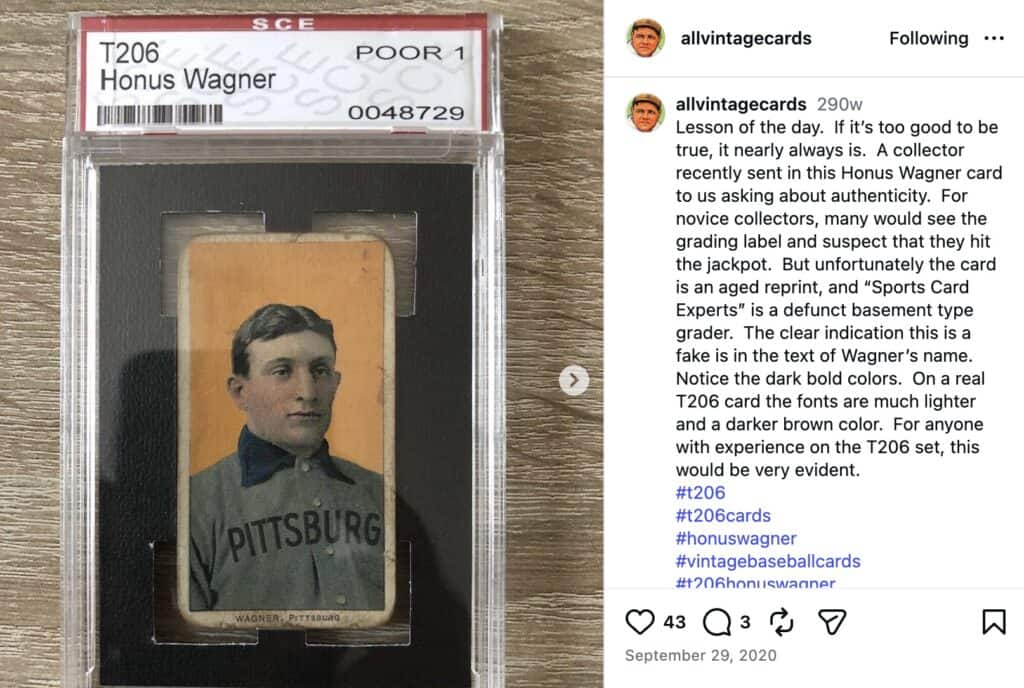
Beyond the back, here’s a fake we authenticated, sent to us by a collector. The giveaway on this one is the font used for Wagner’s name — the lettering on a real T206 card is lighter and a darker brown color. On fakes, the text is often bolder and darker. The grading label is from “Sports Card Experts” — a defunct, non-recognized grader — another immediate red flag.
For a complete breakdown of every authentication tell on the T206 Wagner and the broader T206 set:
→ Complete Guide to Spotting a Fake T206 Card →
The Wayne Gretzky T206 Wagner
The most controversial T206 Wagner card in existence is the one known throughout the hobby as the Gretzky Wagner — the card recorded as having the highest PSA grade in the registry.
In 1991, Wayne Gretzky and LA Kings owner Bruce McNall purchased the card together for $450,000 — a record price at the time and a purchase that brought mainstream attention to the sports card hobby for the first time. Gretzky sold it shortly thereafter to Walmart, which used the card in a customer sweepstakes promotion.
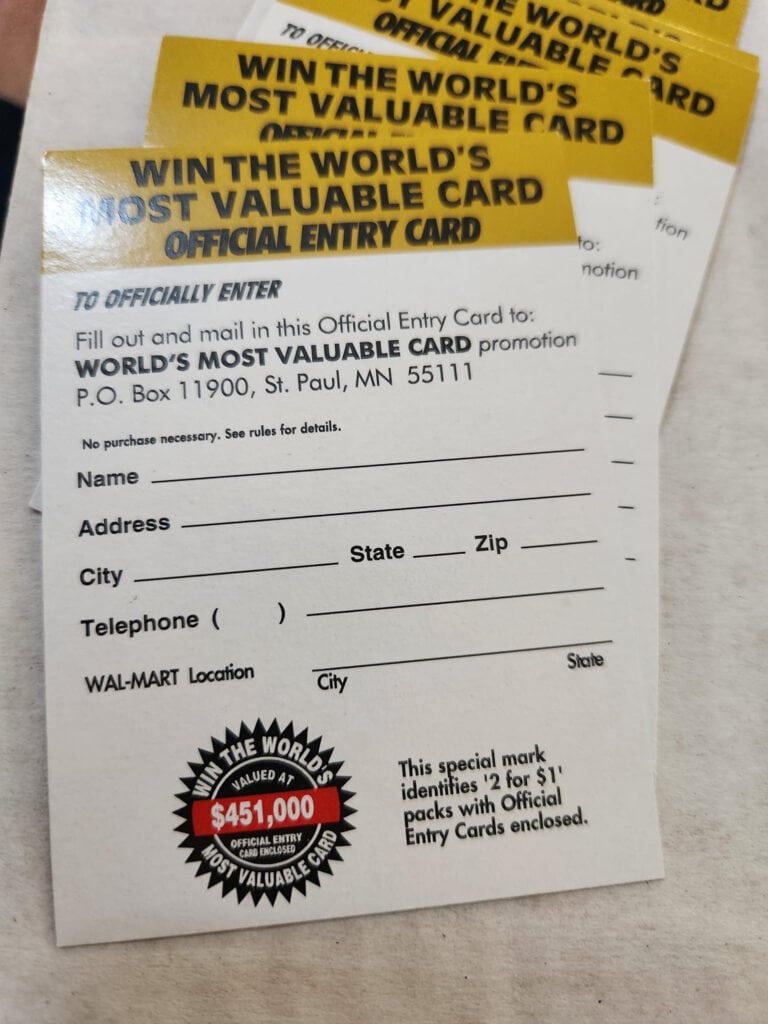
The winner of that promotion eventually sold it, and the card passed through several hands before former Arizona Cardinals owner Ken Kendrick acquired it for several million dollars.

The card held a PSA 8 (NM-MT) grade for years — the highest grade ever assigned to a T206 Wagner — making it the finest known example in the hobby. That status came into serious question when the card was found to have been trimmed by Bill Mastro, a prominent auction house operator who later pleaded guilty to fraud charges related to the card’s alteration.
The full story of the Gretzky Wagner — the purchase, the Walmart promotion, the trimming scandal, and the legal aftermath — is told in remarkable detail in the book The Card, one of the best books ever written about the sports card hobby.
Despite the controversy, the Gretzky Wagner remains listed in the PSA registry and is still considered one of the most historically significant cards in existence — if no longer the finest known example.
T206 Frank Chance Batting HOF ~~ PSA 5 ~~ Sweet Caporal 460/30 back *CUBS*
 | $1,599.99 Buy It on eBay for only: $1,599.99 Buy It Now on eBay |
PSA 10 T206 Honus Wagner TY Cobb Ad Back 2023 Topps 206 1/1 HOF Grail
 | $1,000,000.00 Buy It on eBay for only: $1,000,000.00 Buy It Now on eBay |
1909 T206 Clark Griffith Portrait Cincinnati Reds HOF Sovereign 150 SGC 5
 | $1,600.00 Buy It on eBay for only: $1,600.00 Buy It Now on eBay |
1909-11 T206 Sweet Cap - CY YOUNG HOF, Portrait - SGC 1.5 Crease-FREE Example
 | $2,988.00 Buy It on eBay for only: $2,988.00 Buy It Now on eBay |
T206 Walter Johnson portrait HOF ~~ FR condition ~~ Piedmont 350 back
 | $2,099.99 Buy It on eBay for only: $2,099.99 Buy It Now on eBay |


