
PSA Hikes Grading Costs And Turnaround Times (2026)


All Vintage Cards content is free. When you purchase through referral links on our site, we earn a commission. Learn more
If you’ve been sitting on a stack of mid-grade 1960s or 70s vintage waiting for a “Value” submission, the math just changed.
PSA recently adjusted its Value level pricing, and the ripples are already being felt across the hobby.
For the vintage collector, this isn’t just about a few extra dollars per slab—it’s about a fundamental shift in how we have to look at “the flip.”
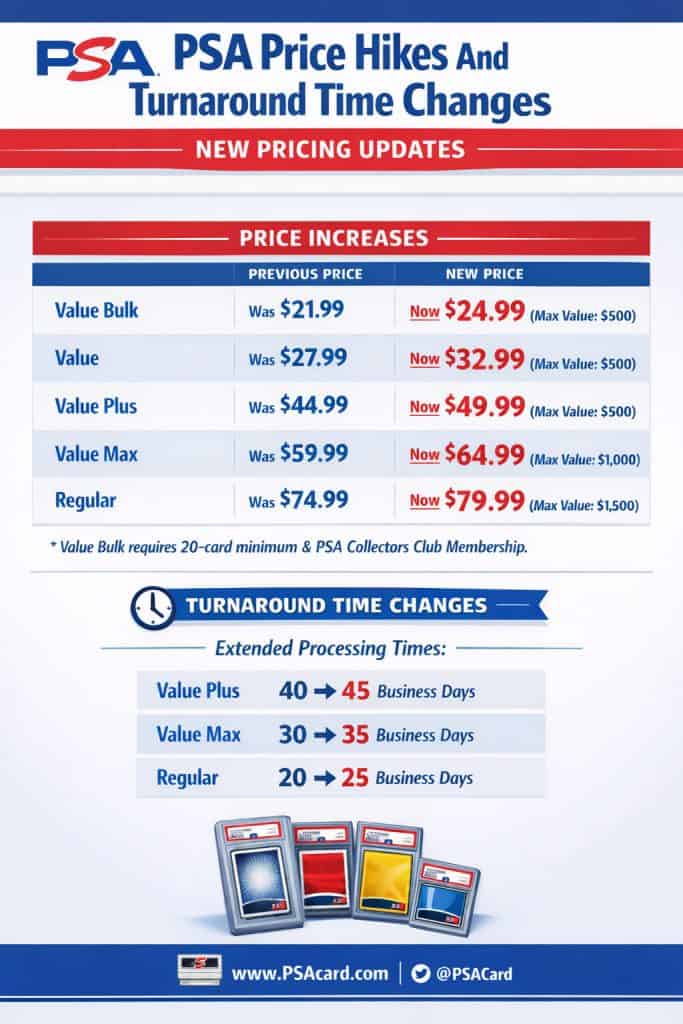
Here are the adjusted prices:
AVC Acquisitions Portal

Sell Your Card Collection
Skip the listing process and long wait times. Get a professional offer on your collection within 48 hours. See our buy list.

- Value Bulk: from $21.99 to $24.99 (maximum insured value $500)
- Value: from $27.99 to $32.99 (max. value $500)
- Value Plus: from $44.99 to $49.99 (max. value $500)
- Value Max: from $59.99 to $64.99 (max. value $1,000)
- Regular: from $74.99 to $79.99 (max. value $1,500)
*Note: Value Bulk requires a 20-card minimum and a PSA Collectors Club Membership.
Turnaround time estimates were also extended for the following service levels:
- Value Plus: from 40 to 45 business days
- Value Max: from 30 to 35 business days
- Regular: from 20 to 25 business days
The New Math: The $25 “Value” Floor
The jump in the Value Bulk tier (now effectively $25 for many) might not sound like much on a single card, but it creates a massive “dead zone” for vintage.
When you factor in:
1. Grading Fee: $25
2. Shipping & Insurance: ~$5-$8 (pro-rated per card)
3. The PSA “Collectors Club” Membership: The annual cost to even access these tiers.
You are now looking at a $30 to $35 “all-in” cost per card.
The $100 Rule
If you are grading a card that will likely return a PSA 5 or 6 and have a market value of $75-$100, the grading cost is now eating 35% to 45% of the total value.
For commons or semi-stars from the 1960s, this makes the “grading for profit” strategy almost impossible.
You are essentially gambling that the card returns a high-enough grade to justify the slab, rather than the slab protecting the value.
What This Means for the Vintage Market
We expect to see three immediate shifts in the next few months:
1. The “Tuxedo” Migration: SGC’s consistent $15/card bulk pricing (and faster turnaround) is becoming the go-to for early pre-war and tobacco cards. For many collectors, the SGC holder looks better with pre-war anyway, and the price gap is now too wide to ignore.
2. Raw is Back: Expect to see a surge in raw sales for mid-grade 1960s/70s stars. Collectors are realizing that a “nice raw EX-MT” card is often a better buy than paying a $35 premium for a PSA 6 holder.
3. Selective Slabbing: Collectors will be forced to be more clinical. “Eye appeal” is no longer enough—you need to be certain of the technical grade before sending it off, or you’ll find yourself underwater on the submission.
The Bottom Line
PSA remains the gold standard for the Registry and high-end liquidity, but for the average vintage “set builder,” the cost of entry just got steeper. Before you pack that next box, do the math: if the card isn’t worth at least $150 in the target grade, you might be better off keeping it in a Card Saver.


