
PSA Grading Costs in 2025 – Full Price Chart, Fees, Upcharges & Bulk Rates
This guide to PSA Grading prices will remain constantly updated. Check back frequently for up to date grading costs.


All Vintage Cards content is free. When you purchase through referral links on our site, we earn a commission. Learn more
PSA grading costs in 2025 typically range from about $22 to nearly $600 per card, depending on your service level, declared value, and turnaround time.
If you’re just looking for the numbers, start with the price chart below — then we’ll walk through upcharges, bulk pricing, and whether it even makes sense to grade your card.
PSA Grading Price Chart (2025)
| Service Level | Max Declared Value | Fee (2025) | Turnaround |
|---|---|---|---|
| Value Bulk (Collector’s Club Required) | $500 | $21.99 | 95 Business Days |
| Value | $500 | $27.99 | 75 Business Days |
| Value Plus | $500 | $44.99 | 40 Business Days |
| Value Max | $1,000 | $59.99 | 30 Business Days |
| Regular | $1,500 | $74.99 | 20 Business Days |
| Express | $2,500 | $149 | 15 Business Days |
| Super Express | $5,000 | $299 | 7 Business Days |
| Walk Through | $10,000 | $599 | 7 Business Days |
Quick PSA Grading Facts
- Cheapest PSA grading option in 2025: $21.99 Bulk (Collector’s Club)
- Cheapest no-membership option: $27.99 Value
- Most common service used by collectors: Value & Value Plus
- Fastest services: Super Express and Walk Through
- Declared value determines which tier you should be in
- If PSA thinks your card is worth more than the tier allows → upcharge
How PSA Upcharges Work
PSA upcharges are one of the more confusing parts of grading. Newer collectors constantly ask about them, so let’s make this simple.
What Is an Upcharge?
An upcharge happens when your card ends up being worth more than the declared value tier you submitted it under.
PSA adjusts your grading fee upward to match the correct tier. This doesn’t affect your grade — it’s strictly a pricing issue.
AVC Acquisitions Portal

Sell Your Card Collection
Skip the listing process and long wait times. Get a professional offer on your collection within 48 hours. See our buy list.

What Is Declared Value And Why It Matters
The ‘declared value’ is your best estimate of what a card will be worth after PSA grades it. This is not an exact science and is mostly used by PSA for insurance purposes.
Assuming that you don’t abuse the system, PSA won’t upcharge you if you are slightly off on value expectations, but if there is a major difference in value post-grading, expect PSA to adjust your grading charge.
A Simple PSA Upcharge Example
Let’s say you submit a Michael Jordan Fleer rookie under PSA’s Value tier:
- Cost: $28 per card
- Maximum declared value: $500
PSA grades your card a PSA 2, which sells for around $2,500.
That value exceeds the Value tier’s $500 limit, so here’s what PSA does:
- PSA emails you explaining the mismatch
- They ask whether you want to proceed
- You pay the fee difference between tiers
In this case, your grading cost jumps from $28 → $149 (the Express tier for a $2,500 card).

How to Avoid Nasty Surprises
- Check comps first. Look up recent eBay sales at your expected grade or check PSA’s recent auction sales.
- If there’s a real chance the card could jump into a mid-four-figure value, consider submitting at a higher tier from the start.
- Don’t try to “game” the system with obviously fake low declared values — that’s how you guarantee an upcharge.
- Note that getting an upcharge from PSA might actually be a good thing, it means your card could be worth a lot more than you initially thought.
Bulk Vs Single Submissions – Pros & Cons
Bulk tiers can save you money, but the rules can trip people up.
Value Bulk (Collector’s Club Required)
- Lower per-card fee (e.g., $21.99).
- Typically require a minimum number of cards, usually 20 cards.
- Limited to cards under a certain declared value cap (here, $500).
- Longer turnaround times, now running at $95 days
- Requires a $149/year investment with PSA’s Collector Club
Bulk makes sense if:
- You’re grading a stack of lower-to-mid-tier cards
- You’re okay waiting longer
- You know most of them won’t trigger an upcharge
- You are grading enough cards to offset the $149 annual fee for Collector’s Club
PSA estimates a turnaround of 95 Business days on Bulk Value submissions, and most collectors I’ve spoken with say this is fairly accurate. This is a big difference from the pandemic days when the estimated turnaround times were grossly inaccurate.
PSA Turnaround Times (Reality vs. Expectations)
The turnaround times in the chart are PSA’s targets, not hard guarantees. In practice:
- Lower tiers (Value, Value Bulk) can run longer if PSA gets slammed with submissions.
- Higher tiers (Express, Super Express, Walk Through) are more reliable, but you’re paying for speed.
- Big hobby events (The National, start of seasons, big auctions) often cause delays.
A good mental model:
- If you need the card back quickly for a show or sale → don’t use Value tiers.
- If it’s a long-term PC or you’re not in a rush → Value and Value Plus are fine.
What’s Your Experience Been With PSA Turnaround Times? Let Us Know In Our Collectors Forum!
Should You Grade Your Card With PSA?
Knowing the cost is only half the battle. The real question is:
Does it even make financial sense to grade this card?
Here’s a simple rule of thumb:
- Look up recent sold listings (not asking prices) for your card in the most likely grade
- Subtract the grading fee + shipping (both directions)
- Ask: “Is there still enough upside here to justify the risk?”
To help collectors make a smarter decision, we’ve built a comprehensive grading calculator that analyzes profitability and gives a clear recommendation: grade it or skip it.
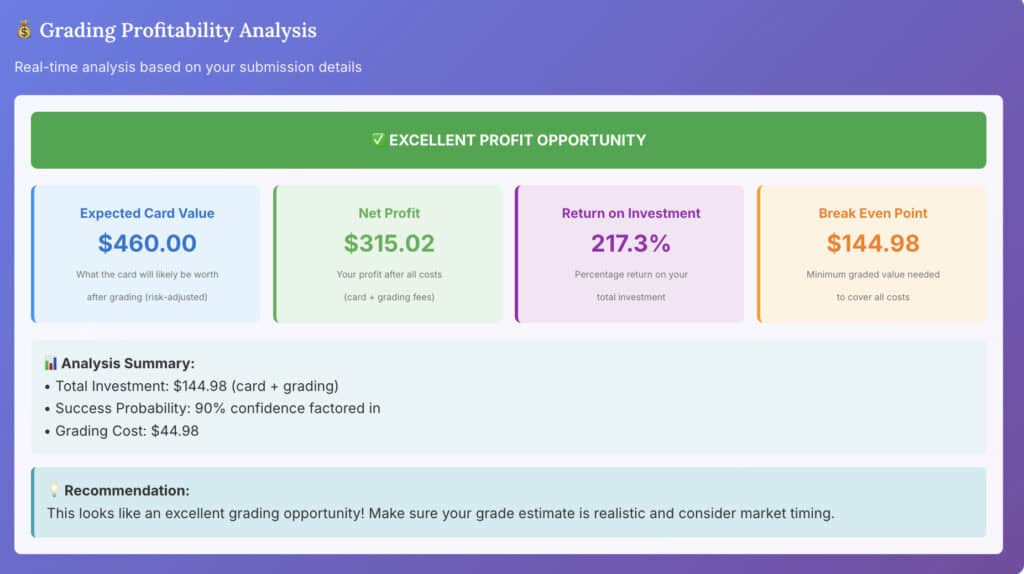
When It Doesn’t Make Sense to Grade With PSA
Even if you love PSA, there are plenty of situations where grading is just lighting money on fire:
- Low-value base cards that will never be worth much even as PSA 10s
- Cards in rough condition (creases, staining, severe corner wear) that are likely PSA 4 or worse
- Modern inserts and parallels that don’t have strong demand even in high grades
- Cards where the graded value barely exceeds the grading fee
As a collector, you don’t want to be in the “spend $75 to add $60 of value” business.
PSA vs Other Grading Companies (Quick Cost Snapshot)
This article is focused on PSA, but cost-conscious collectors sometimes consider SGC, BGS, or CSG instead.
Very simplified:
- PSA – Typically commands the strongest resale premiums, especially for key rookies and iconic vintage. Fees are often higher, but so are sale prices.
- SGC – Often cheaper and faster for vintage; slabs have gained more respect in the last few years.
- BGS / CGC / Others – Niche use cases; can make sense in certain segments, but PSA generally remains the “default” for liquidity.
If your main concern is resale value and liquidity, PSA is still the safest choice for most mainstream cards.
What Are The Other Non-Bulk, PSA Grading Service Levels?
For non-bulk grading submissions, non-PSA Collectors Club Members can submit individual cards at the ‘Value Service’ level for $27.99 per card.
This grading level allows for up to a $500 declared value. PSA claims the ‘Value’ service level will be returned in 75 Business days.

Collectors looking for a quicker turnaround time can opt for the ‘Value Plus’ grading level. Submissions are $44.99, and although PSA retains the declared value of $500, the turnaround time is estimated at only 40 business days.
Collectors can grade higher value cards at the ‘Regular’ grading service, which costs $74.99, has a declared value of $1500 or less, and a much a quicker turnaround time of 20 business days. There is also the “Value Max’ grading service which costs $59.99 and bumps declared or insured value to $1000 and has a 30 business day turnaround.
Collectors with baseball cards valued at $2500 or less can use PSA’s Express service. For even higher-valued cards, look to Super Express ($5000 declared value max, $300 cost) or Walk Through ($10,000 declared value max, $5600 cost) services.
PSA Grading Costs – FAQs
How much does it cost to grade a card with PSA?
Between $21.99 (bulk) and $599 (walk-through), depending on declared value and speed.
Does PSA charge more if the card grades higher?
Yes, through upcharges — but the grade itself does not change.
Will PSA upcharge me for a card worth $1,000?
If you submit it under a tier capped at $500 declared value → likely yes.
Does declared value impact the grade I receive?
No. It only influences insurance and tier selection.
Is bulk submission worth it?
Yes for low-value cards. Not great for anything that might exceed $500 after grading.
What’s the fastest PSA service?
Walk Through (≈ 7 business days).
What’s the best service for most collectors?
Value, Value Plus, or Value Max — depending on card value and turnaround time needs.
Other Grading Articles
Sports Card Grading 101: The Definitive Tutorial
How Hard Is It To Get A PSA 10 Grade?
PSA’s card grading prices have been quite volatile over the past few years.


I would like information as to the proceedure of getting standard size starting line-ups graded. Is shipping them to you in a "Pro tech" case, or the like, encouraged?
Hi Eric, we don’t actually grade cards or figures that is handled by other companies. I do not believe PSA grades action figures but there is a company called AFA that does grade toys. https://cgagrading.com/pricing-and-tier-codes/ Again, I’ve never used them so cannot personally vouch for them. Good luck.
In your experience, are you more likely to get a higher grade through PSA if you declare a higher value? I have a couple of SI kids card where the value of a 10 could be 6 figures while the value of a 7 would likely be around $600. Thus my confusion, Thanks
Hi Glenn, your declared value will have no bearing on the ending grade. The grading companies do have the right to upcharge you if the declared value/grading level is too low…for example in this case, if you submitted with a $600 estimate and it came back a PSA 10, they might upcharge you.
Hello I am new to collecting and I am deciding on what grading company to send my cards to but I wanted to know do you need to be a member to send cards in to PSA for grading. I was told you had to have a membership to get cards graded by PSA but you don’t have to for BGS, or SGC. Thanks for the help.
Hi Lee, none of the grading companies require a membership, however some might offer better deals for members. For example PSA’s Collectors Club offers periodic grading specials and other perks.
I’m so new to this world. Try to catch a break.
Grading is a scam like all big businesses and i wish all collectors would stop, but they won’t..
Hello. I've recently been thinking about grading my cards to get them graded and after researching I think PSA is the one I should go for. But I am on the spectrum a bit so I read things wrong I think
*If I go for the Value tier for say one of my pokemon rumble, let's say Ninetails and its graded at a 10 (which considering how i kept it might be the case) with a worth of $750 I would assume the $60 fee comes on top of that since its over $499. But how this list is put out it also sound like they do not want you to use the service for cards over $499 in general.
*I heard about the $60 fee and I am okay with paying like $85+ shipping for each card I ship in, but I just need to ask to be sure. If the cards are like really rare like one of my mint 2010 HG/SS shiny Gyarados cards which graded 10 would be $1,234.57 do any more fees get added on top of the $60 as well? because if that's the case it feels like they would be forcing you to pay for higher tier stuff without the benefits of faster shipping.
*You might also add that with the initial costs of the tiers, the return paid shipping is also paid by the customer, which is normal, but insurance and import fees are also piled on top of that, which is why I asked about the Gyarados thing, an example would be the Ninetails for my first try $25+$19.50 shipping + $60 value fee + ? shipping back + $34 insurance costs + ? import costs. That racks up at least to $135.
I mean I'm cool with doing it since I am sending in one card to then sell it to fund sending in the others but this just makes me look at the tiers like there is a real chance of scamming myself.