The Ultimate Guide To Michael Jordan Rookie Cards


All Vintage Cards content is free. When you purchase through referral links on our site, we earn a commission. Learn more
Michael Jordan’s rookie cards have anchored the modern basketball card market for almost four decades. But the mix of Fleer and Star releases has left many collectors unsure about what actually counts as a rookie — and why values differ so much.
This guide breaks everything down clearly: the true rookie card, the XRC Star issues, how rare each card actually is, current market values, how to authenticate them, and where to buy or grade safely.
Here’s the quick facts collectors should know:
- Jordan’s true rookie card: 1986 Fleer #57
- Sticker rookie: 1986 Fleer Sticker #8
- Earlier Star cards (1984–85): Considered XRCs, not pack-issued rookies
- Total “rookie-year” Jordan cards: 5
- Values (2025): ~$3,000 to $1,000,000+ depending on card and grade
- Most counterfeited: The 1986 Fleer #57 by far, however, the Star #101 is highly counterfeited as well.
| Card | Year | Brand | Type | True RC? | Notes |
|---|---|---|---|---|---|
| 1986 Fleer #57 | 1986 | Fleer | Pack-issued | YES | The recognized rookie card |
| 1986 Fleer Sticker | 1986 | Fleer | Sticker | YES (Sticker RC) | Tough in high grade |
| 1984-85 Star #101 | 1984 | Star | XRC | XRC (rookie-year) | Jordan’s first NBA-licensed card |
| 1984-85 Star #195 | 1984 | Star | XRC | XRC | Gold Medalist |
| 1984-85 Star #288 | 1984 | Star | XRC | XRC | ROY |
What Counts as Michael Jordan’s Rookie Card (Fleer vs Star)?
Michael Jordan’s official rookie card was released in 1986, not 1984 or 1985.
AVC Acquisitions Portal

Sell Your Card Collection
Skip the listing process and long wait times. Get a professional offer on your collection within 48 hours. See our buy list.

The hobby’s universally recognized rookie card for Jordan is:
1986 Fleer Michael Jordan #57 (true rookie card)
This card came from Fleer’s first true basketball product since 1961 and was distributed in traditional wax packs, making it the only pack-issued Jordan rookie card.

Jordan also has a second true rookie from the same Fleer issue:
1986 Fleer Sticker #8 (sticker rookie)
Collectors treat this as the official “sticker rookie” — still a rookie-year issue, but printed and distributed as an insert. Stickers came one per pack, and are notorious for gum stains on the front and back of the card. Note that these can be removed with dryer sheets, but be careful!

So What About the 1984–85 Star Cards?
One year before Fleer returned to basketball, Star Company held the exclusive NBA license and produced three Michael Jordan cards in its 1984-85 issue. These are Jordan’s first NBA-licensed cards, and were issued in his actual rookie year with the Bulls. They are also notoriously scarcer than the 86 Fleer issue and now hugely important historically, especially now that PSA has resumed grading Star cards after a long hiatus

The most important of the three is the 1984–85 Star #101, Jordan’s first NBA-licensed card. Some collectors argue that this should be considered Jordan’s real rookie card, and it’s easy to understand that line of thinking. But in the hobby’s formal definition, it falls just short. Since the cards weren’t pack-issued, Beckett designated them as XRCs (Extended Rookie Cards) back in the 1980s — a label that has stuck ever since.
That said, the idea of what counts as a “rookie card” has evolved. As more collectors recognize how early and scarce the Star cards are — and with PSA’s renewed involvement — you’ll hear stronger arguments that the #101 deserves the same respect (or more) than the Fleer rookie. Purists, in particular, see the Star issues as the truest representation of Jordan’s rookie-year cards, even if the technical definition says otherwise.

How Many Michael Jordan Rookie Cards Exist?
While only two Michael Jordan cards are formally recognized as true rookies — the 1986 Fleer #57 and the 1986 Fleer Sticker — there are five total cards issued during his rookie season or rookie-card window. The remaining three come from Star Company’s 1984–85 release, which are classified as XRCs.
Here is the complete group at a glance:
| Card | Year | Brand | Classification |
|---|---|---|---|
| 1986 Fleer #57 | 1986 | Fleer | True Rookie |
| 1986 Fleer Sticker #8 | 1986 | Fleer | Rookie-Year Sticker |
| 1984–85 Star #101 | 1984–85 | Star | XRC |
| 1984–85 Star #195 | 1984–85 | Star | XRC |
| 1984–85 Star #288 | 1984–85 | Star | XRC |


How Rare Are Michael Jordan Rookie Cards?
Many collectors believe the 1986 Fleer Michael Jordan rookie card is a rare card, but that is not true.
Based on estimates from Reed Kasaoka, a longtime hobby veteran and buyer at Dave & Adams, Fleer printed 250K copies of each card in the 1986 Fleer Basketball set.
”With regards to how many Jordans were printed, in the late-90s a high-level Fleer executive told me in there were 250,000 of each card printed for 1986/87 Fleer Basketball. Is this a realistic number? I suppose so, considering it was their first basketball product. He also said because of the product’s disappointing reception on the market, they cut production in half for 1987/88.
– Reed Kasaoka, Buyer, Dave & Adams Card World
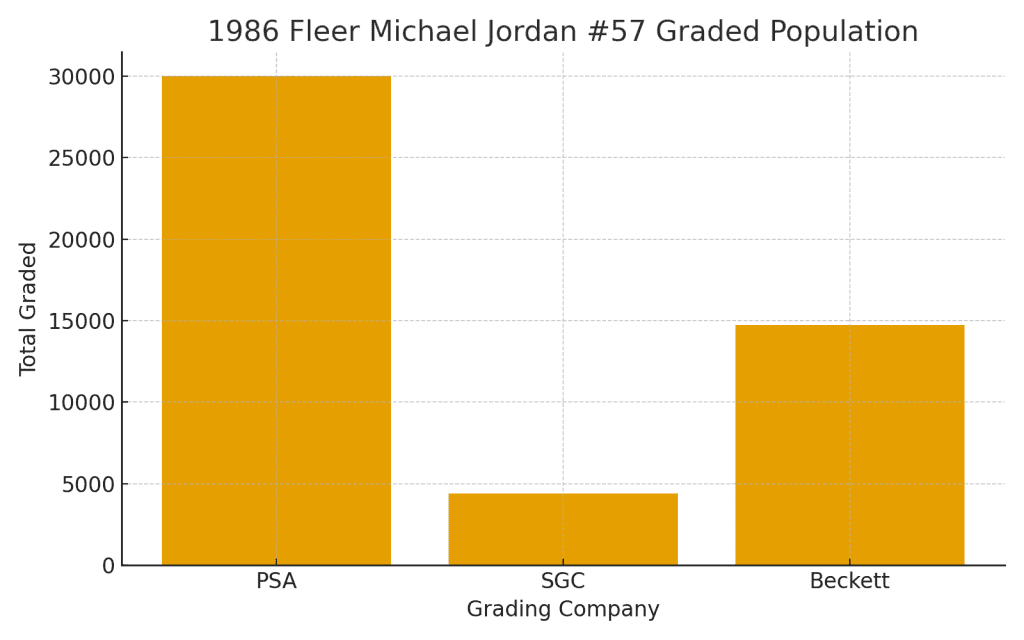
86 Fleer Jordan #57 – Graded Population Today
~30,000 PSA-graded Jordan rookies
~14,700 Beckett-graded
~4,500 SGC-graded
50,000+ total graded copies in the market
For a card often referred to as “rare,” the actual supply is substantial.
Star Jordan XRCs Are Far Scarcer
In contrast, the 1984–85 Star Company basketball sets were distributed in very small quantities — mostly through team bags, hobby dealers, and NBA arenas.
Estimated production for the Jordan Star cards versus the Fleer rookies:
| Michael Jordan Rookie Card | Estimated Print Run |
| 1986 Fleer Jordan #57 | 250,000? |
| 1986 Fleer Jordan Sticker | 250,000? |
| 1985 Star Jordan #101 | 5,000? |
| 1985 Star Jordan #195 | 5,000? |
| 1985 Star Jordan #288 | 5,000? |
How Much Is A Michael Jordan Rookie Card Worth?
For decades, the 1986 Fleer #57 has been considered the hobby’s “blue-chip” Jordan rookie — the card everyone recognized, chased, and valued highest.
That is no longer the case.
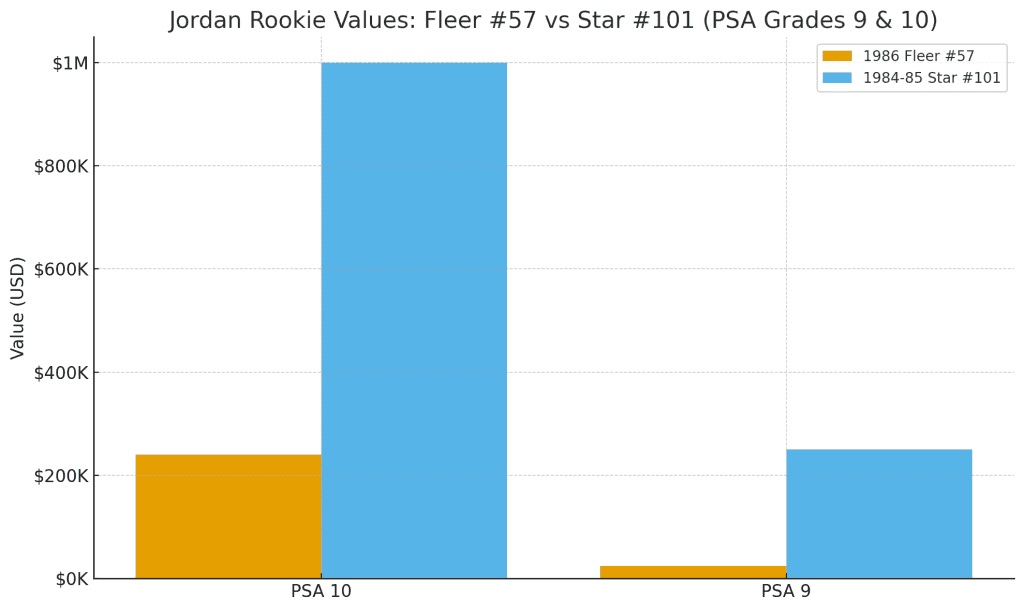
Today, the 1984–85 Star #101 — Jordan’s first NBA-licensed card — has surpassed the Fleer rookie in high-grade value by an enormous margin.
The Star #101 Jordan in PSA 9 now sells for 4× the price of a Fleer PSA 10, and over 40× the price of a PSA 9 Fleer rookie.
| Card | Grade | Approx. Value |
|---|---|---|
| 1984–85 Star #101 | PSA 9 | $1,000,000+ |
| 1984–85 Star #101 | PSA 8 | ~$250,000 |
| 1986 Fleer #57 | PSA 10 | ~$240,000 |
| 1986 Fleer #57 | PSA 9 | ~$24,000 |
| 1986 Fleer Michael Jordan #57 (True Rookie) | ||
| Grade | Value (2025) | Notes |
|---|---|---|
| PSA 10 | $240,000 | Premium market leader |
| PSA 9 | $24,000 | Strong collector demand |
| PSA 8 | $10,000 | Mid-grade sweet spot |
| PSA 7 | $7,000 | More affordable |
| PSA 2–5 | $3,000–$5,000 | Entry-level |
| 1986 Fleer Sticker #8 | ||
| PSA 10 | $40,000+ | Very tough in high grade |
| PSA 9 | $6,000 | Centering issues common |
| PSA 8 | $2,000 | Popular alternative |
| 1984–85 Star Company Jordan XRCs | ||
| Star #101 PSA 9 | $1,000,000+ | Jordan’s first NBA-licensed card |
| Star #101 PSA 8 | $250,000 | Low population |
| Star #101 BGS 7 | $70,000 | Grading crossover in flux |
| Star #195 PSA 7 | $15,000 | Gold Medalist |
| Star #195 PSA 6 | $5,000 | |
| Star #288 PSA 7 | $8,500 | Rookie of the Year |
| Star #288 PSA 6 | $6,500 | |
Why Prices Swing So Much
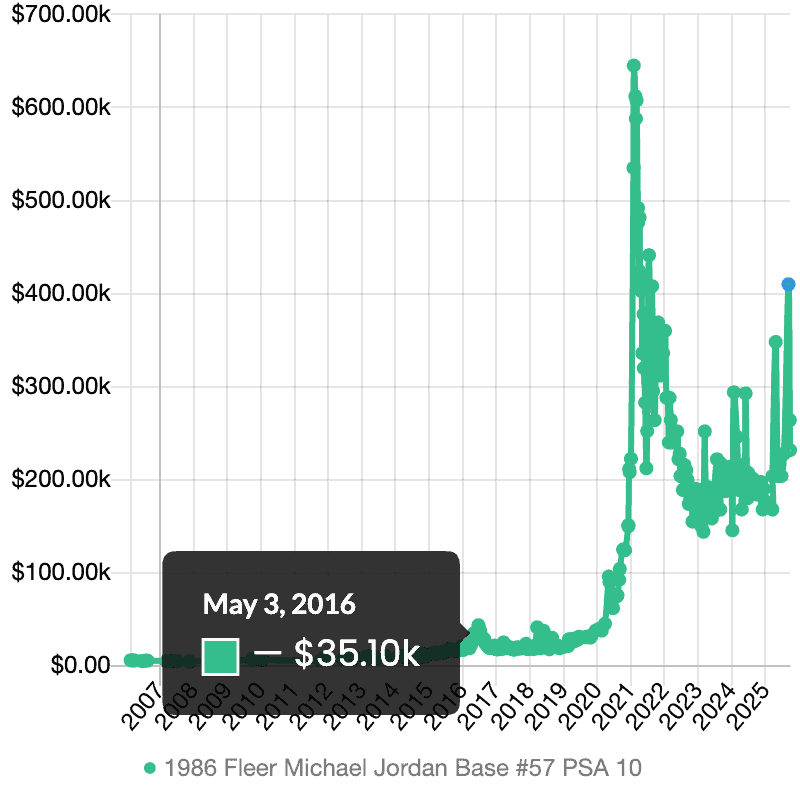
The 1986 Fleer Jordan rookie card has experienced big swings in value in recent years. There was a huge spike during the pandemic-fueled card bubble, followed by a massive decline as collectors realized things had gotten way out of hand.
At the peak in 2021, a Gem-Mint Jordan Fleer rookie shattered records, selling for $738,000. Since that sale, the value of a PSA 10 Fleer Jordan has fallen by a mind-boggling 78%. It might take a very long time for that buyer to get back to even.
Today, a PSA 10 Fleer Jordan is valued at around $240,000.
Jordan rookies are heavily influenced by:
- overall sports card market cycles
- grading company changes (like PSA grading Star)
- counterfeit fears (especially for Star and Fleer raw)
- collector nostalgia
- limited supply of high-grade examples
How Do I Tell If My Jordan Rookie Card Is Real Or Fake?
The 1986 Fleer Michael Jordan rookie is one of the most counterfeited sports cards ever made, and even experienced collectors can be tripped up by the better fakes. Many knockoffs are easy to spot when you have a common Fleer card from the same set to compare against, but others require a closer look.
One of the more reliable tells on the genuine card is a tiny white print defect on the back, just above the “CORP” line in the footer. It looks like a small chip in the pink background and appears on every authentic copy of the card. Good counterfeits often miss this entirely, or they replicate it poorly.

The printing quality on the real card is also noticeably sharper. Counterfeits tend to have fuzzier text, softer dots in the halftone photo, and different gloss or card stock. Centering isn’t a giveaway — plenty of real Fleer Jordans are badly centered — but poor color saturation and mismatched blue tones on the border usually are.
The bigger issue in recent years has been fake slabs. Counterfeiters have produced shockingly convincing PSA and Beckett holders, complete with fake labels and serial numbers. If the card is slabbed but something feels “off,” always look up the certification and compare the flip, case style, and font to known examples. Any inconsistency is a red flag.

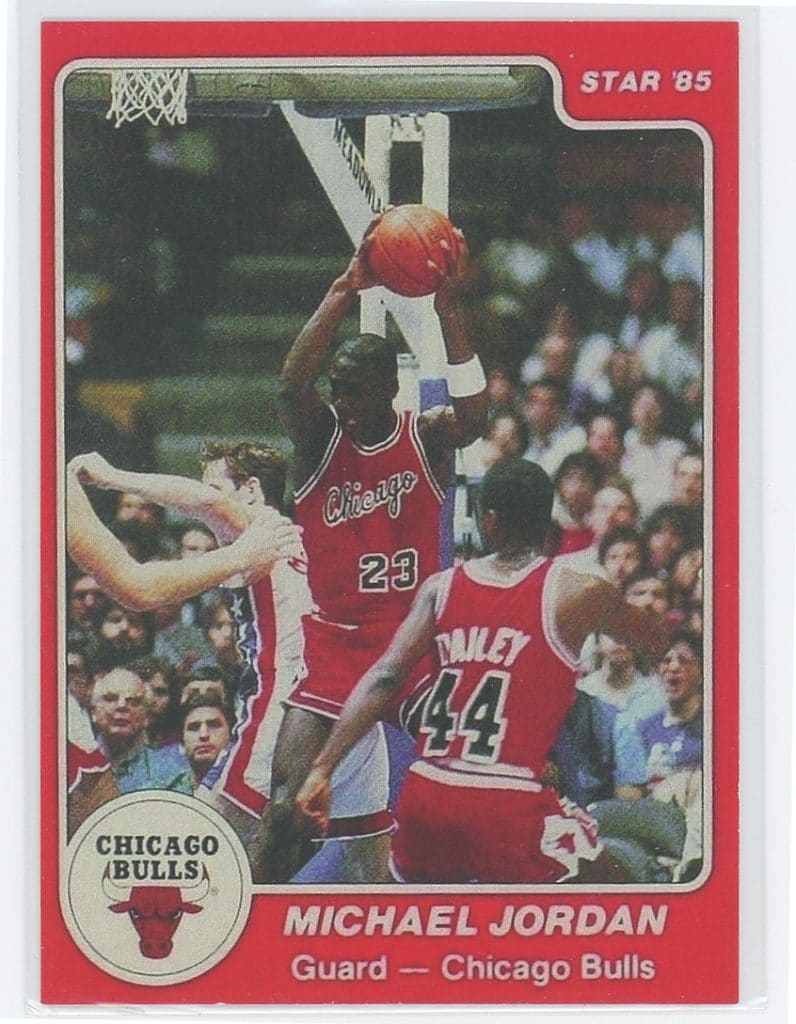
For the Star Jordan cards, the authentication challenge is even tougher. The original sets were printed differently from modern cards, and the counterfeit market has been active for decades. Anyone buying a raw Star card should proceed cautiously. If you’re considering a higher-end Star #101 or one of the other Jordan XRCs, it’s worth sticking to graded examples from PSA or BGS unless you’re extremely familiar with Star’s production quirks.
If you’re ever unsure, feel free to post photos on the All Vintage Cards Forum — I try to respond to as many authenticity questions as I can. A second set of eyes can save you a lot of money.
Are Jordan Rookie Reprints Worth Anything?
Most reprints of the 1986 Fleer Jordan rookie card have no real monetary value. The majority were created either as novelty inserts, unlicensed reproductions, or outright counterfeits meant to fool buyers. Anything that mimics the Fleer rookie too closely — especially the ones with fake aging or “vintage” gloss — is essentially worthless.
There are, however, a few legitimate reprint-style Jordan cards from the 1990s that collectors treat as their own separate inserts rather than knockoffs of the true rookie. The best-known example is the 1996 Ultra “Decade of Excellence” Jordan, which uses the same design as the Fleer rookie and has become a popular standalone card with its own market. Another is the 1996–97 Stadium Club Finest Reprint, which even has a refractor version that collectors chase.


These cards aren’t rookies in any sense, but they do have a following, and clean graded copies can sell for meaningful prices. Just don’t confuse them with the countless “replicas” floating around online — those have little to no collectible value.
What’s The Long-Term Investment Potential For Jordan Rookie Cards?
Values for Jordan rookie cards have been anything but stable over the last few years. The hobby boom during the pandemic pushed the 1986 Fleer rookie to levels that were never sustainable, and once the frenzy cooled, prices fell sharply. A PSA 10 that brought over $700,000 at the peak now trades closer to the mid-$200K range — still an important card, just not the runaway “blue-chip” it was marketed as in 2020–21.
What’s changed is where collector demand is flowing. The attention that once centered almost exclusively on the Fleer rookie has shifted toward the Star Company cards, especially the 1984–85 Star #101, Jordan’s first NBA-licensed card. For years the hobby treated it cautiously because PSA wouldn’t grade it. Once that barrier fell, the market reacted immediately — and the #101 is now worth dramatically more than the Fleer rookie in high grade.
The supply gap between the two cards is the real driver. Fleer printed hundreds of thousands of rookies; Star’s production run was tiny by comparison, and high-grade examples are legitimately scarce. As more collectors realize the imbalance — and as PSA continues to add Star cards to its population report — the long-term trajectory still favors the early Star issues.
A Quick Reality Check on Today’s Prices
Three years ago, I made a point of stressing that the Star #101 had better long-term upside than the Fleer rookie. I wrote:
If you are looking to invest in a Jordan rookie card, I recommend considering any of the Star Jordan rookies. Due to their limited population, I believe they have better long-term potential.
That call turned out to be spot-on. Once PSA re-entered the Star market, demand surged, and the #101 exploded in value — far beyond the Fleer rookie.
But here’s the honest take today:
The highest-grade Star #101s may be running too hot.
Investor money has poured into the top of the Star market, and PSA 9 examples have climbed into price territory that feels stretched. Scarcity is real — but when a card jumps from under $200K to seven figures in a few years, you have to at least acknowledge the possibility of a mini-bubble forming at the very top.
That doesn’t mean the Star run is over. It does mean the best value may no longer be the #101 PSA 9s and 8s that are already priced like blue-chip art pieces.

Where the opportunity is shifting
If you’re looking for better long-term value without swimming in the deep end:
- Star #195 and #288
Still historically important, far lower population than Fleer rookie still, and nowhere near as inflated as the #101. - Second-year Star Jordans
These are still meaningfully scarce and sit in that sweet spot between nostalgia and low supply. - Oddball subsets (Gatorade, Crunch ’N Munch, etc.)
These are quietly gaining collector attention and have room to run—especially in higher grade.
The main point — demand for Star is absolutely justified, but collectors should be thoughtful about where in the Star lineup the best future value really sits.
Where Can I Safely Buy A Michael Jordan Rookie Card?
eBay is still a great place to shop for any Jordan rookie card, and thankfully, eBay now offers more peace of mind with its ‘Authenticity Guarantee’ program.
Many collectors are tempted to buy raw, ungraded Jordan rookies to save money; however, given the amount of fakes in circulation, I strongly suggest purchasing a graded copy.
You can save some money by purchasing a graded Jordan rookie from any non-PSA gradings company like SGC, Beckett, or CSG. The reason is that PSA-graded Jordans sell for a premium. Buy one in an SGC slab for example and you can crossover to PSA to earn a premium on any sale.
Also, look at our store; we often have Jordan rookie cards for sale.
Where Should I Get My Michael Jordan Rookie Card Graded?
I recommend PSA for grading any Michael Jordan rookie card. PSA now also grades any Star Jordan rookies. Ultimately, PSA will provide a significant premium to either SGC or Beckett.

Check out our Michael Jordan PSA Grading Guide for a visual guide to the 1986 Fleer Jordan Rookie card in various conditions.
How Do I Sell A Michael Jordan Rookie Card For Top Dollar?
Again, eBay is a great, liquid marketplace for selling your cards. For high-grade Jordan rookies, you can also consider an online auction house. PSA now offers the ability to sell directly through eBay after grading. This is a great option since you don’t need to handle any shipping or payment collection.
All Vintage Cards is always buying high-quality cards, so feel free to reach out!
Is Jordan’s Second Year Fleer Card Worth Anything?
Jordan’s 1987 Fleer second-year card has a much lower-graded population than his 1986 Fleer rookie card. Still, the 87 Fleer card is only worth a fraction of his rookie cards.
Why Are Rookie Cards Worth More Money?
A PSA 10 1987 Fleer Jordan is worth about $15K to $20K, although mid- to higher-grade copies can be found for under $1000 in many cases.
Keep a heads up for fake copies, as many are floating around.